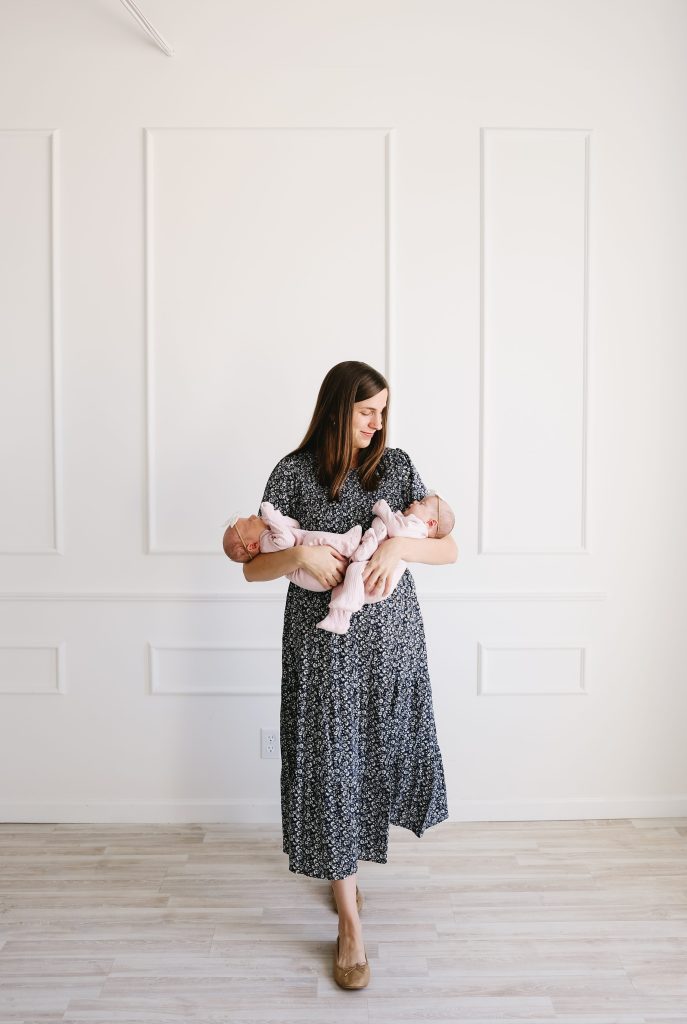
May is Maternal Mental Health Awareness Month, and given that I’m currently only eleven weeks postpartum with twins, I decided to focus my writing on my postpartum experience thus far, as well as on my first postpartum journey almost six years ago.
I went into my first pregnancy blissfully unaware of the toll that motherhood could take on one’s mental health. I truthfully don’t even think I had heard of postpartum depression or anxiety ever before. To be fair, I was only nineteen when I found out I was pregnant, so why would I have? None of my friends had babies. I had never spent any time around new moms. I grew up in a community that only ever focused on all of the positives of having kids — the newborn smell, their cute coos, all of the adorable little outfits. No one ever mentioned that I might be a puddle of tears for days or weeks after coming home from the hospital. I had never heard anyone say that in the weeks following childbirth, they had questioned whether or not they wanted to live.
Not before my first pregnancy, anyways. During one of my first OB/GYN appointments, I was told all about the symptoms that were to come. Nausea, vommitting, food aversions, acne, moodiness, insomnia, exhaustion, etc. All normal for pregnancy, I was told. Then I learned about what would come after childbirth. Baby blues, more acne, more exhaustion, bleeding for weeks, intrusive thoughts, thinning hair, uncontrollable anxiety, and more. My OB gave me a pamphlet on PPD and PPA, with a number to call if I started to struggle, and I was on my way.
Six days after giving birth, I was rocking my daughter in our living room while she screamed so loudly that I thought my eardrums would burst, and all I could think about was how I didn’t want to be there. Not in that room, not in that apartment, not in that city, and not even on planet Earth. I squeezed my eyes shut and fantasized about how satisfying it would be to chuck a glass dinner plate off of my balcony and watch it shatter into pieces. For some reason, hearing my daughter cry triggered a flight response, and all I wanted to do was run away. This stirred up horrible feelings of guilt. What kind of mother was I if I didn’t immediately try and cuddle and soothe a crying baby? What type of “motherly instincts” made my head feel like it was going to explode just because I couldn’t calm her down within sixty seconds?
I never gave in to the intrusive thoughts of chucking dinnerware onto pavement, but it crossed my mind frequently enough to scare me. Every upset, every witching hour, ever unconsolable crying fit, would all leave me feeling frazzled and angry, followed by guilt for feeling that way. I would drive over to my mom’s house, both me and the baby crying the whole way, and then I would leave my mom’s house shortly afterwards, still crying, because I couldn’t get the baby to calm down and felt bad for burdening everyone else with our noisy presence.
It wasn’t until several months postpartum that I realized the problem was me. No one seemed to get as worked up about my baby crying as I did. My mom or my sister or even my husband were able to calmly triage the situation and go about trying to soothe her without wanting to yell or break something. The problem was me.
Once I realized this, I began to do some research. And like all new moms, this research consisted of some legitimate medical sources, but also Facebook groups and Reddit threads. I had heard of postpartum depression and anxiety, but it wasn’t until this instance that I had heard of postpartum rage — nobody had ever mentioned that to me before. I scrolled through what seemed to be dozens of comments of moms experiencing the same thoughts as me.
“Every time I can’t get my baby to sleep, I just feel so angry, like I could punch a wall!”
“I thought I would never even think about harming my baby, and then I became a mom.”
“I had NO IDEA postpartum rage was a thing.”
“I felt very explosive — never felt my child was in danger, but felt like I could have ripped the house apart with my bare hands.”
There were these, and so many more comments. Suddenly, I felt a little less alone. I began to realize that maybe nothing was “wrong,” with me, but that what I was experiencing was more common than I thought. Maybe the problem wasn’t me, but simply that no one warned me about what was to come.
I went into my second pregnancy more prepared, but also more nervous. At my first appointment with my OB/GYN, as soon as we found out it was twins, my OB let me know that many twin moms reported even worse PPD and PPA. She explained that medically, this was caused by the double amount of hormones in your body due to their being two babies, instead of just one. She knew that I struggled the first time, and just wanted me to be aware.
A lot had changed between my first pregnancy and my twin pregnancy. Nearly five years had gone by. I went to therapy for years. I got divorced and remarried. I moved a few times, and started law school. In many ways, I felt much more emotionally stable and self-aware, but I knew that wouldn’t guarantee anything.
But much to my surprise, the twins were born, and at first… nothing. I spent weeks waiting for the other shoe to drop, so to speak, but my postpartum experience was overall pleasant. I recovered more quickly than I did with my first, the baby blues never crept in. I felt like myself, and not some shell of myself. I was able to balance taking care of the babies and my older daughter and pumping and even law school, along with everything else, without feeling like the weight of the world was on my shoulders.
A few weeks into it, though, I realized why. My husband was being incredibly supportive, and even took over all of the night shifts with the twins so that I could focus on pumping and resting. We had a three-week-long meal train, organized by my mom and the women’s group at my church. People came over to help do dishes, fold laundry, play with the older kids. And almost anytime I was alone with the twins, I would venture over to my mom’s house or a local walking trail, so that I could slowly build my confidence in tackling outings with twins by myself. It all seemed to good to be true.
Eventually, though, the meals stopped coming. The visitors stopped by less frequently. My husband had to return to work, and people resumed their normal lives. I suddenly found myself home alone with the twins a lot more often. Luckily, PPA and PPD seemed to stay at bay. But the postpartum rage did not.
The first time it hit me, the twins were probably six or seven weeks old. They were fighting against nap time like their lives depended on it, and their cries were growing louder by the minute. My older daughter was at home, sitting at the kitchen table, watching it all happen. Anything that could go wrong, was going wrong. Puking. Blowouts. Head-buts. You name it, and it was happening. I could practically feel the frustration beginning to boil under my skin. I remembered how, with my first, I would fantasize about dropping a plate off of the balcony.
I had no balcony, and no plate that I was willing to spare, so I grabbed a spare drinking glass, went into the backyard where my daughter couldn’t see me, and chucked the glass against the pavement. It shattered into tiny pieces, making a satisfying crash! sound, and then…nothing. I didn’t feel better, not in the way I thought I would. The rage was gone, but it was simply replaced with embarrassment. “What are you, twelve?” I said to myself.
I swept up the glass, went inside, put on noise cancelling headphones and blasted Noah Kahan’s music, and resumed trying to get the twins down for a nap. The headphones proved to be much more effective at calming my rage than finally giving in to smashing something was, and I vowed to not let my rage get the best of me again.
That doesn’t mean it went away. For some reason, weeks six to ten were still really hard. Everything irritated me, from the sound of my kids Magna-tiles to the way my husband changed a diaper to the sight of a messy kitchen. This time around, the postpartum rage was there, but it just looked different. Most of the time, it looked like becoming instantly overstimulated by normal childhood noise. It looked like my shoulders tensing the second both babies started crying at once. It looked like snapping at my husband over something insignificant and then feeling immediate shame afterwards.
And unlike postpartum depression, which people talk about with understanding, sympathy, and even pity, anger feels ugly. Unacceptable. Especially as a mother. Sad moms get concern. Angry moms get judged.
Nobody tells you that postpartum rage can coexist with deep love for your children. That you can be incredibly grateful for your babies and still occasionally feel like your nervous system is short-circuiting under the pressure of caring for them. Nobody tells you that hormones, sleep deprivation, sensory overload, physical recovery, and the complete loss of personal space can make even the most patient person feel explosive.
I think that’s why so many women suffer silently through it. Because admitting that motherhood sometimes made us feel angry feels dangerously close to admitting that we are bad mothers, even when the two are not the same thing.
I have no “solution” to end this with. I’ve found things that help — noise-cancelling headphones, running my hands under water, and exercise, to name a few — but nothing truly “fixes” postpartum rage, or any postpartum mental health issue, for that matter. Those are discussion best had with your provider and your support system anyways.
I’m simply here to shed light on a topic that so many women still feel too ashamed to talk about, and to let any mom struggling with postpartum rage know that you are not alone, and you are not a bad mother.


Man!! First off, absolute power to you and your twins! I have to say this was such an important read.
I am a first-time mom, and just like you, I never I mean NEVER heard of postpartum rage. Honestly, I hadn’t really heard of PPD, PPA, or the baby blues either. But that rage! It was intense. For me, it came from months of running on a maximum of three hours of sleep and navigating exclusive breastfeeding. I couldn’t understand why I just wanted to scream and punch a wall. On top of that, the sound of my son crying would send me into a deep depression because I couldn’t handle the noise, so we tried everything to keep him from crying at the top of his lungs.
But back to the anger. I remember reaching the point where I just couldn’t hold it in anymore. Just like you, I took a plate and threw it against the wall. It messed up the wall and shattered everywhere. I ran upstairs, slammed the door, cried into my pillow, and just drifted off to sleep. Did it help? Only for a split second.
Thank you for sharing this so rawly. It makes the rest of us feel so much less alone in the dark.
LikeLiked by 1 person