“Is that another one?”
With those four words, life as I knew it changed forever.
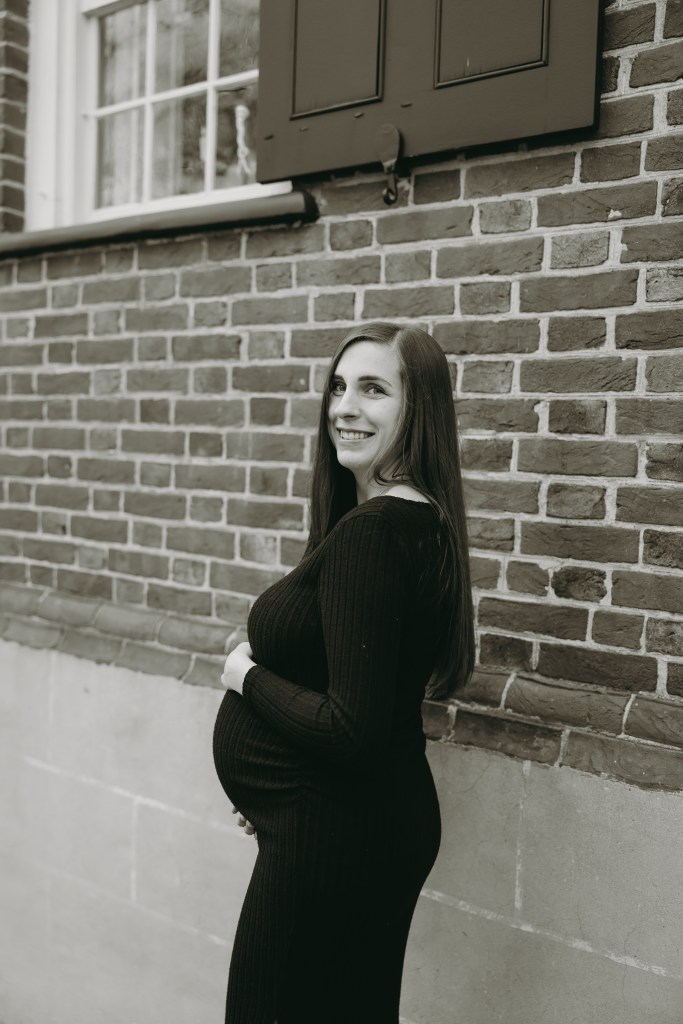
I spotted the second baby on my eight-week ultrasound before the tech even pointed it out. Since I already suspected that I was pregnant with twins, my husband and I had processed some of the shock and anxiety that comes with the news beforehand. So when we saw our two little babies on that ultrasound screen, our first reaction was excitement! I was looking forward to sending photos of that ultrasound to friends and family and telling the kids.
Of course, there were plenty of things that my husband and I were worried about: Where would we fit two new babies in our small home? Would I need a bigger car? How would we afford two babies? How would we afford daycare for two babies while I finished school? Beyond those surface-level concerns, however, and beyond my fears of being deathly ill during pregnancy (like I was with my first child), there wasn’t too much more that I was worried about.
But I remember the second that my reality shifted again, and a new type of anxiety crept in.
After the ultrasound, we were led to my OB/GYN’s office to meet with her and discuss a care plan for moving forward. I have been seeing the same OB since I was 19, so she has been my healthcare provider through a lot of major life changes, including the birth of my first child, my divorce, my college graduation, and my marriage to my now-husband. When she came in, we excitedly caught up and I introduced her to my husband, who she hadn’t met before.
Once she sat down, though, the first thing she said was, “So as I’m sure you know, since you’re pregnant with twins, that does technically put you in the high-risk category.” I was stunned. She was right, I did know that twins were considered high-risk, but that thought hadn’t crossed my mind once during the previous month of assuming that I was having twins. For some reason, hearing that my pregnancy was high-risk was a shock.
Those early weeks of pregnancy were spent wrapping my mind around this new reality, all while trying to survive the first trimester. My OB and I had a discussion about the odds of needing a C-section, the risks of birth, and possible NICU time, all months earlier than we had discussed it during my first pregnancy. In fact, NICU time was something that was never even on the table the first time around. But this time, it had to be addressed. I found myself stressing about my birth plan before I even knew the genders of the babies.
More Ultrasounds, Scans, & Appointments
A high-risk pregnancy meant more ultrasounds and appointments. Since I had been extra anxious from early on in the pregnancy, on the one hand, the extra scans were nice. Every chance that I got to see my babies healthy and thriving provided some relief. But I was also aware that the only reason I was even having extra scans was because my babies were more at risk, so then I would become anxious all over again. It was a vicious cycle.
I would often get the “pre-scan jitters,” where I would get nervous about all of the horrible things that the ultrasound might reveal. I would convince myself in the days leading up to a scan that I was feeling the babies move less or that something was wrong, as if to brace for the worst possible news. Everything was always fine, but it was definitely on my mind that there was a higher chance things could go wrong.
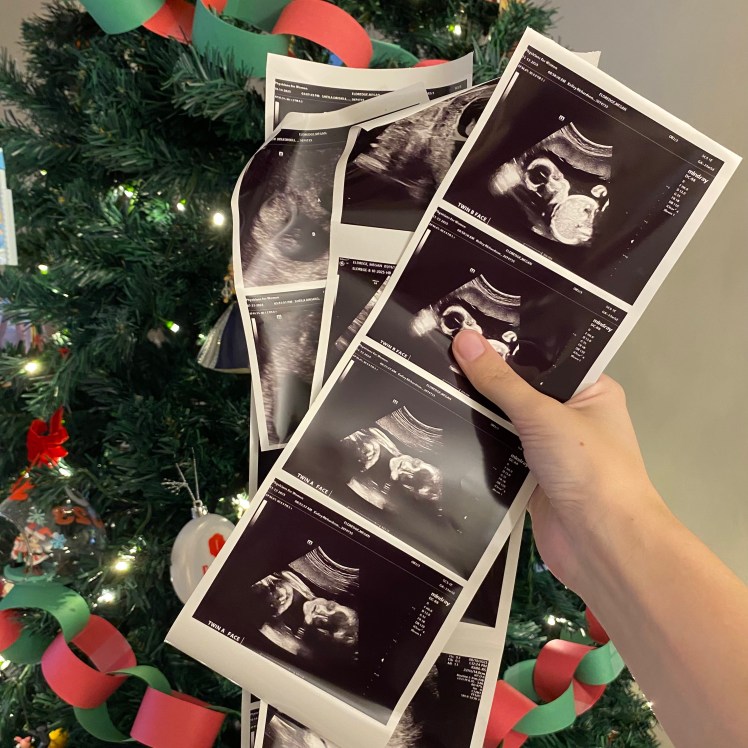
At first the ultrasounds were monthly, then twice a month, and towards the end, weekly, so I ended up with a LOT of ultrasounds! Many moms told me how jealous they were that I got so many extra scans, but past 20 weeks, they grew more and more painful, and the babies were so big compared to a typical twenty-week anatomy scan that there wasn’t much to see. By the end, one photo could only fit a head or a torso!
“When’s the Due Date?”
Another side effect of a high-risk pregnancy is the dreaded, well-intended question: “When are you due?”
I never figured out a great way to answer this. When I returned to school in the fall after having summer off, right around the start of my second trimester, this was understandably everyone’s first question. Before I really sat down and accepted that I truly have zero control this pregnancy, this question stressed me out. I knew from that first appointment that I would not be allowed to carry the twins past 38 weeks. So even though my “due date” (i.e. 40 weeks) was March 8th, the babies would be born no later than February 22nd. But the reality with twin pregnancies is that you are lucky if you even make it to 38 weeks, and this uncertainty surrounding a due date is a common thread in many high-risk pregnancies.
I know several twin moms who did make it to 38 weeks or even later! But I also know of even more twin moms whose babies were born between 34 and 38 weeks, with some coming as early as 30 to 34 weeks. In light of those possibilities, I’ve known from the beginning that we should plan on the twins being born sometime in January or even December, just to be safe. That’s a pretty huge window! This made it very difficult to answer what for most expecting moms is a simple question. Unless it was someone close to me, I eventually just started telling people that I was due at the end of February.
Luckily, the “nesting” urge hit hard around 20-24 weeks, so I rolled with it and had almost everything ready by 26 weeks. The nursery was done except for a few items of decor, the hospital bag was packed with at least the minimum essentials, and I prepped a week’s worth of freezer meals to have ready for postpartum. I even had my baby shower around 25 weeks, just to make sure I was feeling my best and could be as prepared as possible. Was all of this an overkill? Maybe a little. But it was better than living with the constant stress of not knowing whether your babies will be born at 30 or 38 weeks, and being caught unprepared. Once I hit 32 weeks and realized how miserable those last few weeks of pregnancy would be, I was extremely glad that I prepared early!
Higher Chance of Complications
A high-risk pregnancy usually means that you have a higher chance for complications. Since I was pregnant with twins, I had an increased risk of being diagnosed with gestational diabetes, preeclampsia, and anemia, among other things. Suddenly, every mundane, routine test they make you take at the OB office had an extra layer of stress on top of it because I was very aware that they could be positive. I (maybe naively) never had that concern when I was pregnant with my first. Luckily, I had what I am now calling the most boring twin pregnancy ever, and I had NO complications, but the extra stress still took its toll.
There was a time where I wasn’t sure if I would make it to 30 weeks pregnant. I think I let all of the stories of twin moms who deliver between 24 and 29 weeks get to my head, and for some reason, I thought that would be me. So by the time I did make it to 30 weeks, I was almost hyper-vigilant about monitoring my symptoms, which many other twin moms I’ve spoken to say they also struggled with in the third trimester.
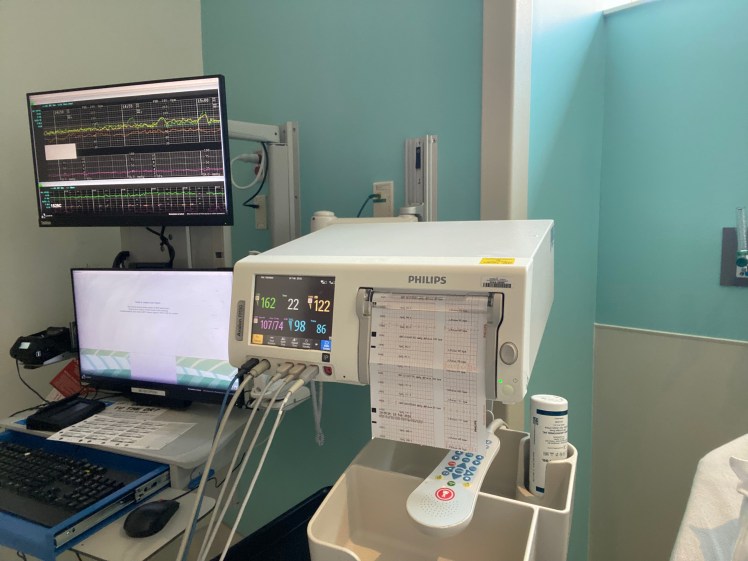
This led me to visiting the hospital’s maternal assessment unit two times during those last few weeks. The first time, I was having consistent contractions at only 31 weeks. I was given IV fluids and monitored for several hours, after which I was sent home with instructions to, “stay horizontal as much as possible and push fluids.” The second time, my blood pressure was so high at a routine OB visit that they sent me straight to the hospital based on concerns of preeclampsia. The doctor even implied that she’d be surprised if I made it through the weekend without going into labor. This was at only 34 weeks pregnant. I instantly began to panic. 34 weeks would mean guaranteed time in the NICU, and although I had always known that could be a possibility, I wasn’t ready for that to be my reality.
Miraculously, by the time I made it through triage, my blood pressure completely stabilized and all of my other symptoms had faded. Without any current issues, despite the symptoms I had earlier in the day, the hospital had no reason to keep. I was cautiously sent home, where I was determined to last even a few more weeks.
Preparing for a Risky Delivery
Included in the higher chances for complications during pregnancy is also the higher chances of complications during delivery. When most people hear “twins,” they automatically think “C-section,” and that assumption isn’t completely baseless. Depending on how the twins are positioned in utero, the training and comfort level of the OB, the mother’s pregnancy or pre-existing conditions, and a variety of other factors, a C-section is often the safest choice. In fact, approximately 75% of all twin pregnancies in the United States end in a C-section, and nearly 50% of twin pregnancies result in premature birth.
Given those odds, I naturally prepared for both surgery and NICU time. Baby B (which is a clinical term for the baby higher up in the uterus) was transverse my whole pregnancy, meaning that there was no way to tell which way she would decide to come out after her sister. If she were to be breech, only about half of the providers at my clinic felt comfortable performing what’s called a breech extraction vaginally, and instead preferred the safety of the OR. Since there was no way to read the future, we went ahead and booked a C-section for 38 weeks on the dot.
At first, I felt great about this decision. I researched everything I would need to recover from a C-section, as well as what to expect. I purchased a belly binder and high-waisted underwear. I made arrangements around the house in order to be able to avoid the stairs as much as possible. I told myself that it was the safest option.
The rest of this story will be in my post about actually giving birth, but long story short, I opted out of a C-section last minute. The stars aligned and my primary OB was the one who was on call at the hospital the day I was to be induced, and she felt confident that a C-section could be avoided… as long as I was okay with the risks. Because that’s the thing with high-risk pregnancies: there’s no way to 100% remove the unknown.
The Risk Is Worth the Reward
Obviously, in the end, the whole pregnancy was more than worth it. Our two perfect girls were born three minutes apart in an operating room, no C-section needed, and my pregnancy ended as medically uneventfully as the whole pregnancy had gone by. The second that my daughters were placed on my chest, all of the worry and stress that I had carried for months just melted away. We made it to the finish line of 38 weeks. I was healthy and the girls were healthy. Yes, my pregnancy was higher risk because I was carrying two babies instead of one. But now I’m blessed with twice the snuggles, twice the wonder, and twice the love. The risk was absolutely worth the reward, and I can’t believe I’m saying this, but I would do it all again in a heartbeat.
 Step by Step Parenting